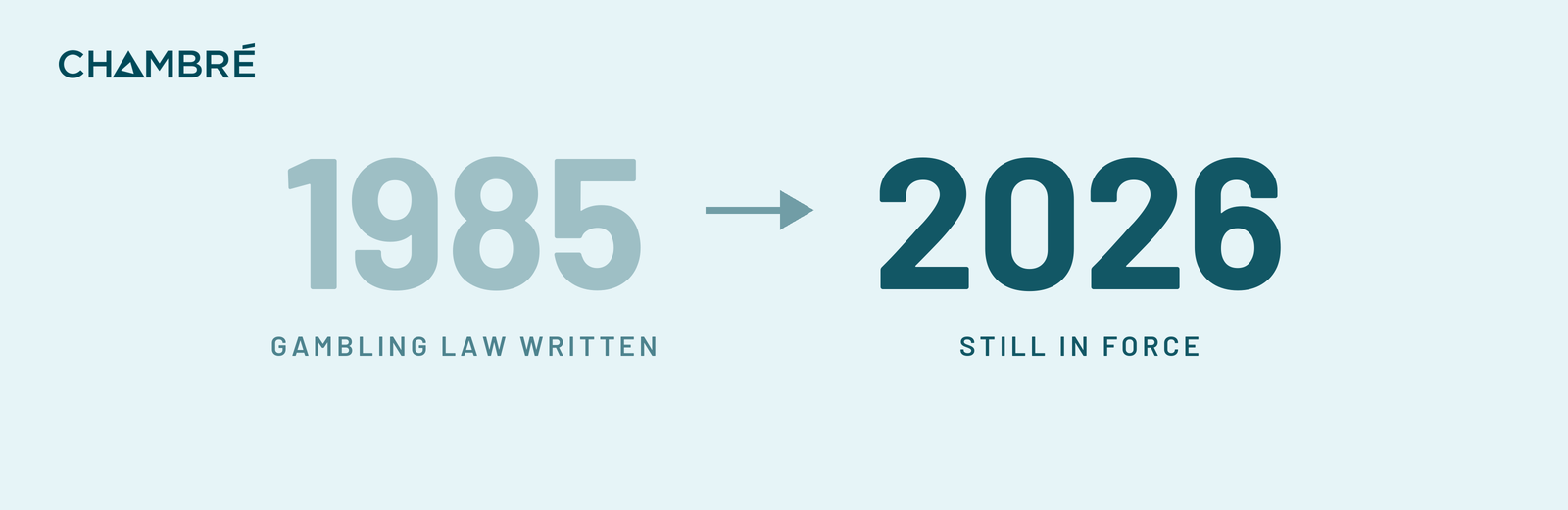
Between 1865 and 1895, the American frontier was a place of rapid expansion and lawlessness, forever immortalised in popular culture by the spaghetti westerns of Italian director Sergio Leone. Settlers and speculators raced into new territory faster than the law could follow, and in the gap between opportunity and regulation, vast fortunes were made. However, for every story of fortune, there were countless stories that ended in ruin. It is a history we like to think belongs to another century. Yet in one corner of these islands, a version of it is playing out today. The frontier is digital, the speculators are online gambling operators, and the territory is Northern Ireland, where an industry that lives on smartphones is governed by a law passed in 1985, before the internet even existed. Just how did Northern Ireland fall so badly behind?Northern Ireland’s gambling market operates in something close to a legal vacuum. The law governing it — the Betting, Gaming, Lotteries and Amusements (Northern Ireland) Order 1985 — was written for betting shops, bingo halls and fruit machines, in a world without the smartphones we all now carry in our pockets. Four decades on, it remains the primary legislation covering an industry that has been completely transformed by the internet and digital technology. Right now, Northern Ireland has no dedicated regulator. It has no statutory levy on gambling operators to fund treatment or prevention services. There is no regulatory oversight of remote gambling at all.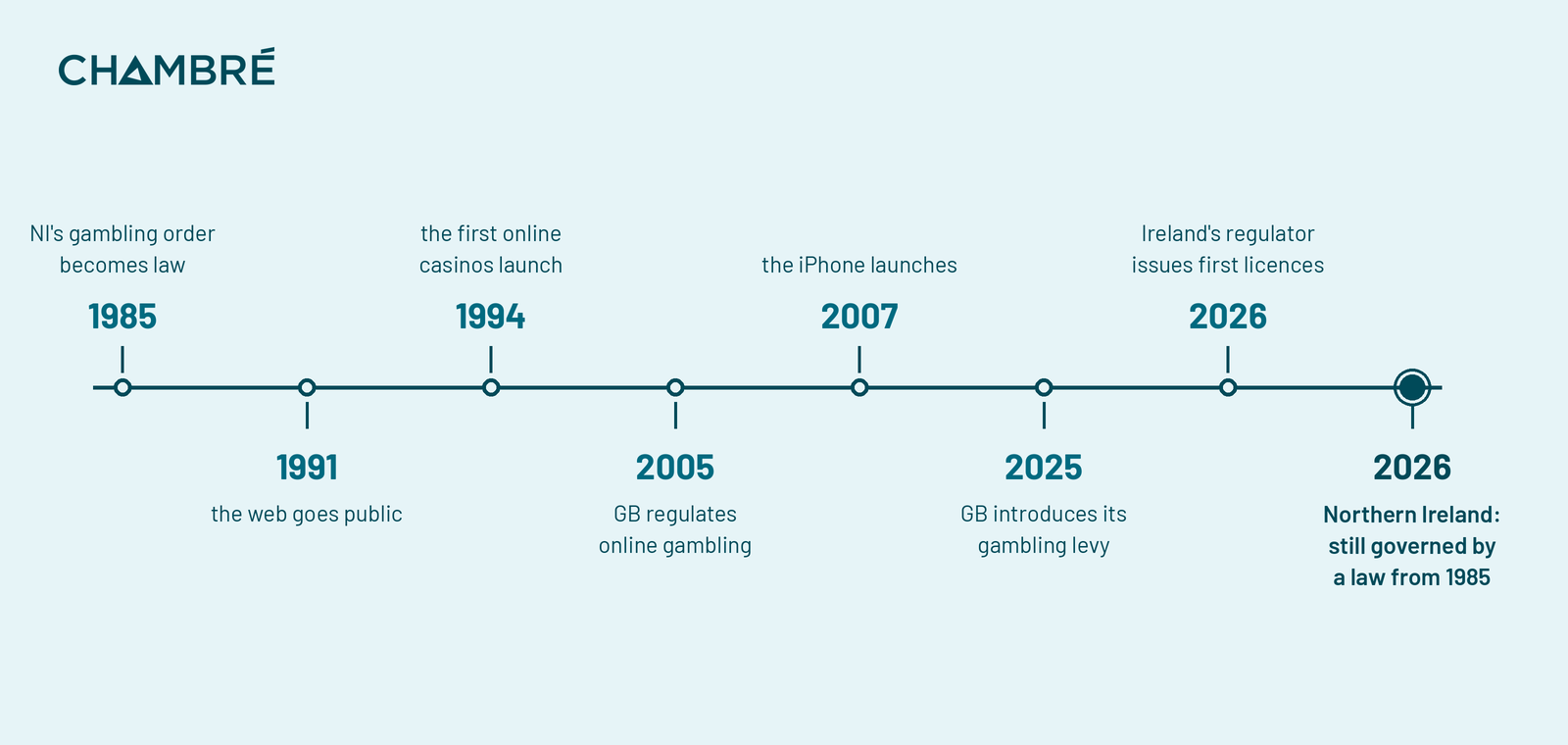 In the Republic of Ireland, gambling regulation has recently been transformed. The Gambling Regulatory Authority of Ireland, established under the Gambling Regulation Act 2024, issued its first betting licences in July — replacing laws dating back to 1931 and 1956 with a modern regulator, backed by a Social Impact Fund and new groundbreaking restrictions governing gambling advertising and marketing.In Great Britain, the direction of travel has been the same. The Gambling Act 2005 was an early attempt to grapple with online gambling, but even it was quickly outpaced by technology — the then Government’s own 2023 white paper described it as an analogue law in a digital age. Reform since has been real but unhurried. A statutory levy on gambling operators now ring-fences funds for research, prevention and treatment, and last month the Gambling Commission announced it will begin rolling out staged financial risk assessments for online gambling customers — light-touch checks designed to catch harmful losses before they spiral.None of this applies in Northern Ireland.A punter in Belfast and a punter in Liverpool can open the same app, deposit into the same account, and bet on the same markets. Only one of them does so under a regulatory framework designed for the world they actually live in. That is not to say Great Britain has solved the problem — campaigners argue its reforms still fall short, not least on advertising. — but it is at least working on it.
 This would matter less if Northern Ireland’s relationship with gambling were healthier than its neighbours’. The evidence points the other way. The Department for Communities’ 2024 Gambling Prevalence Survey found that 3% of adults here meet the threshold for problem gambling — up from 2.3% in 2016, and higher than the rate in Great Britain (2.4%). It also found that 14% of people who gamble say they have bet more than they could afford to lose. Behind those statistics sit tens of thousands of individuals, families and workplaces absorbing the harmful consequences.In the Assembly’s defence, the picture is not one of total inaction. The Betting, Gaming, Lotteries and Amusements (Amendment) Act 2022 delivered useful reform: a new offence of inviting under-18s to play gaming machines, a duty on the Department to issue a code of practice for operators, and even a power to introduce a levy on land-based operators to fund support for those harmed by gambling. However, the record since tells its own story. The code was consulted on in late 2024 and has yet to be published. The levy power has never been brought into operation, so not a penny has been raised. The Act was, in any case, explicitly billed as phase one of a two-stage process. The harder questions — an independent regulator, and any regulation of online gambling at all — were deferred to a phase two that has never materialised.The costs of that inaction are becoming harder to ignore. Currently, there is no local regulator to license and inspect operators, or to sanction those who cause harm — leaving enforcement to an already stretched PSNI. Every advance in Great Britain or the Republic of Ireland — affordability checks, advertising restrictions, safer gambling tools — widens a gap that most locals rarely realise exists until something goes wrong.Legislation on this scale does not happen quickly. A comprehensive Gambling Bill — one that establishes a regulator, addresses remote gambling, secures sustainable funding for prevention, treatment and research, and builds in protections for children and young people — would need to be introduced early in the next Assembly mandate to have any realistic prospect of completion. That means the groundwork must start before the May 2027 election, not after it: departmental preparation, cross-party consensus, and manifesto commitments that survive contact with a Programme for Government negotiation.
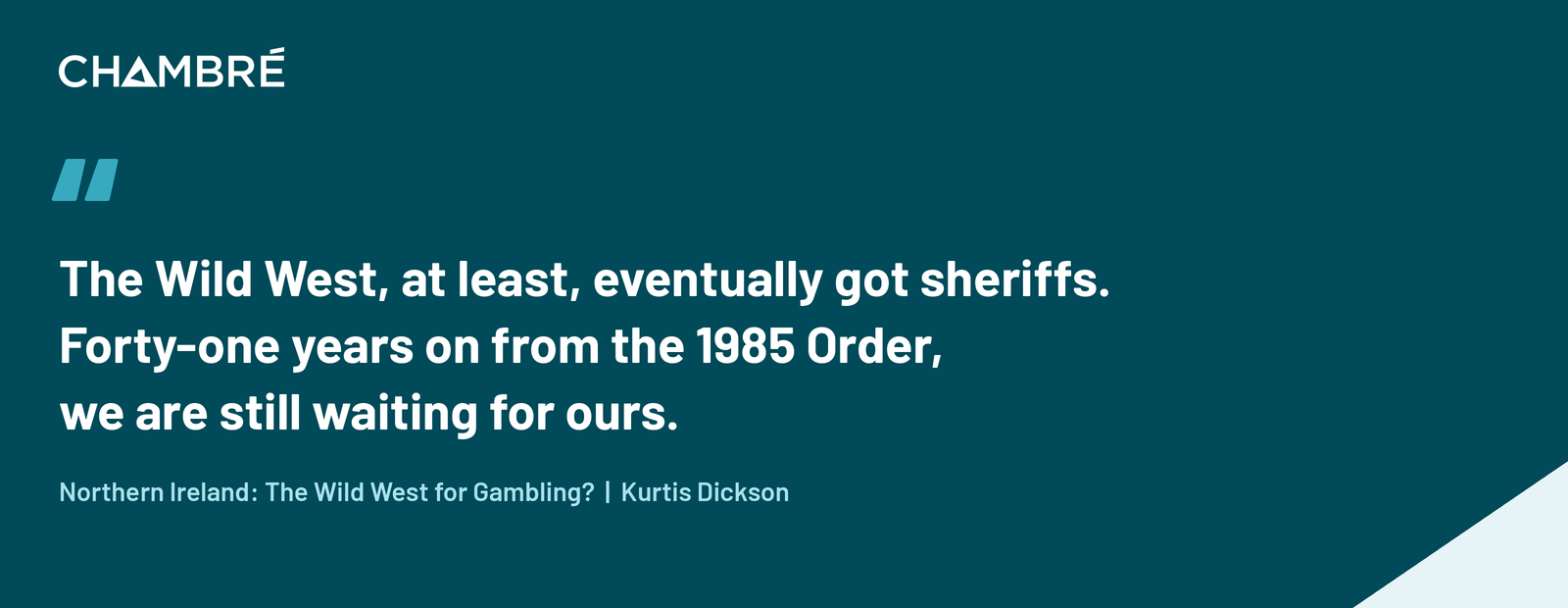 So, is Northern Ireland the Wild West for gambling? The metaphor is imperfect — the Wild West, at least, eventually got sheriffs. On both sides of us, our neighbours now have theirs. Forty-one years on from the 1985 Order, we are still waiting for ours.
In the Republic of Ireland, gambling regulation has recently been transformed. The Gambling Regulatory Authority of Ireland, established under the Gambling Regulation Act 2024, issued its first betting licences in July — replacing laws dating back to 1931 and 1956 with a modern regulator, backed by a Social Impact Fund and new groundbreaking restrictions governing gambling advertising and marketing.In Great Britain, the direction of travel has been the same. The Gambling Act 2005 was an early attempt to grapple with online gambling, but even it was quickly outpaced by technology — the then Government’s own 2023 white paper described it as an analogue law in a digital age. Reform since has been real but unhurried. A statutory levy on gambling operators now ring-fences funds for research, prevention and treatment, and last month the Gambling Commission announced it will begin rolling out staged financial risk assessments for online gambling customers — light-touch checks designed to catch harmful losses before they spiral.None of this applies in Northern Ireland.A punter in Belfast and a punter in Liverpool can open the same app, deposit into the same account, and bet on the same markets. Only one of them does so under a regulatory framework designed for the world they actually live in. That is not to say Great Britain has solved the problem — campaigners argue its reforms still fall short, not least on advertising. — but it is at least working on it.This would matter less if Northern Ireland’s relationship with gambling were healthier than its neighbours’. The evidence points the other way. The Department for Communities’ 2024 Gambling Prevalence Survey found that 3% of adults here meet the threshold for problem gambling — up from 2.3% in 2016, and higher than the rate in Great Britain (2.4%). It also found that 14% of people who gamble say they have bet more than they could afford to lose. Behind those statistics sit tens of thousands of individuals, families and workplaces absorbing the harmful consequences.In the Assembly’s defence, the picture is not one of total inaction. The Betting, Gaming, Lotteries and Amusements (Amendment) Act 2022 delivered useful reform: a new offence of inviting under-18s to play gaming machines, a duty on the Department to issue a code of practice for operators, and even a power to introduce a levy on land-based operators to fund support for those harmed by gambling. However, the record since tells its own story. The code was consulted on in late 2024 and has yet to be published. The levy power has never been brought into operation, so not a penny has been raised. The Act was, in any case, explicitly billed as phase one of a two-stage process. The harder questions — an independent regulator, and any regulation of online gambling at all — were deferred to a phase two that has never materialised.The costs of that inaction are becoming harder to ignore. Currently, there is no local regulator to license and inspect operators, or to sanction those who cause harm — leaving enforcement to an already stretched PSNI. Every advance in Great Britain or the Republic of Ireland — affordability checks, advertising restrictions, safer gambling tools — widens a gap that most locals rarely realise exists until something goes wrong.Legislation on this scale does not happen quickly. A comprehensive Gambling Bill — one that establishes a regulator, addresses remote gambling, secures sustainable funding for prevention, treatment and research, and builds in protections for children and young people — would need to be introduced early in the next Assembly mandate to have any realistic prospect of completion. That means the groundwork must start before the May 2027 election, not after it: departmental preparation, cross-party consensus, and manifesto commitments that survive contact with a Programme for Government negotiation.So, is Northern Ireland the Wild West for gambling? The metaphor is imperfect — the Wild West, at least, eventually got sheriffs. On both sides of us, our neighbours now have theirs. Forty-one years on from the 1985 Order, we are still waiting for ours.Kurtis Dickson is an Account Executive with Chambré