The Ulster Unionist Party arrives at conference in a very different position from the one it occupied a year ago. Its recent polling has moved it ahead of the DUP, while the party has a new dynamic leader who has proven himself capable of presenting a new vision of political unionism and weathering the multiple political dramas that have come his way. That gives the UUP an opportunity to present itself as a credible alternative within unionism and, more broadly, as a party capable of influencing how the Executive operates. However, the conference also comes at a point of transition, following the resignation of Mike Nesbitt as Health Minister and with questions still open about the party’s policy offer, internal cohesion and ability to convert polling support into electoral gains.
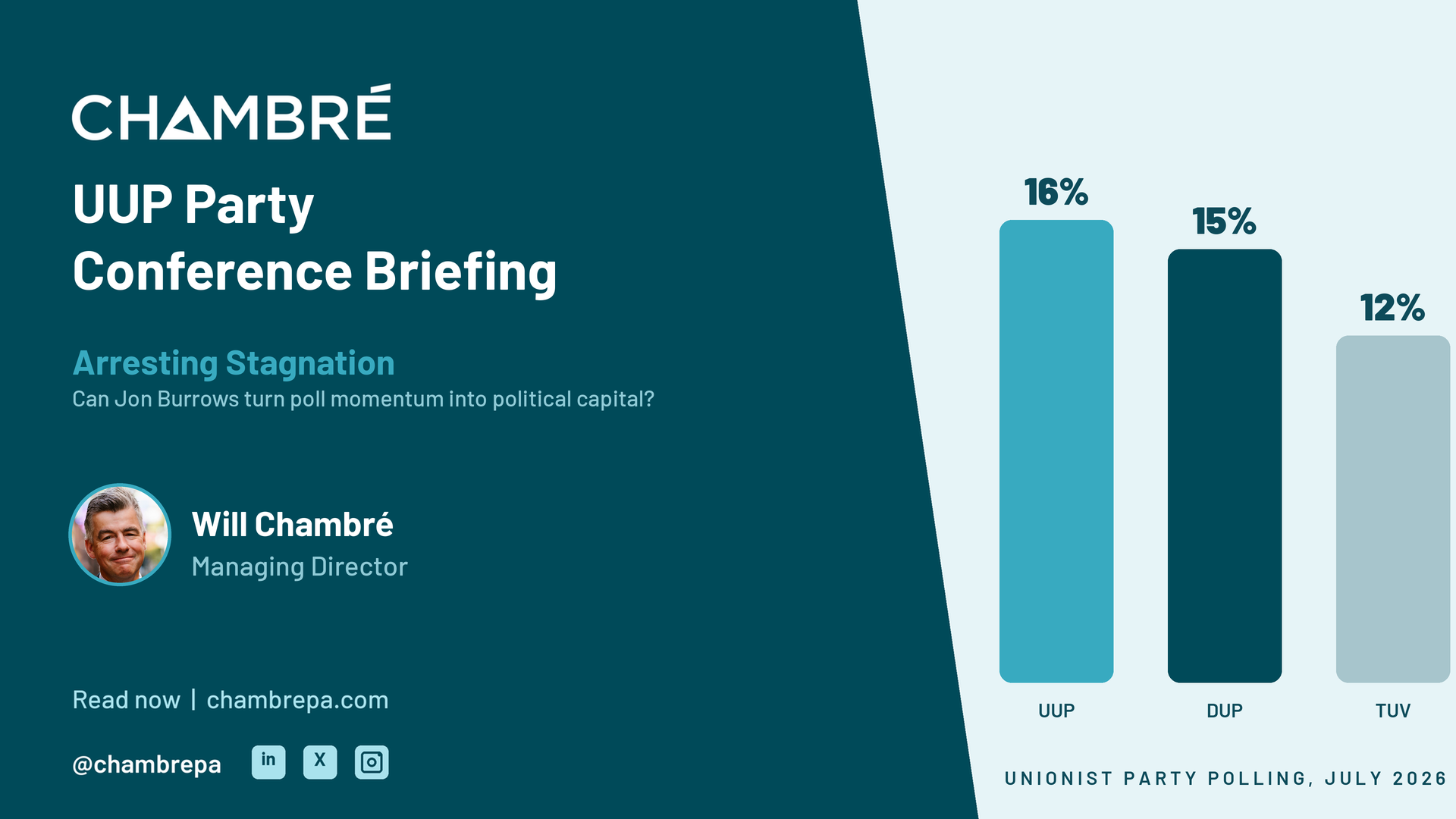
The latest LucidTalk tracker for the Belfast Telegraph put the UUP on 16%, one point ahead of the DUP on 15%. Sinn Féin is on 22%, the SDLP on 13%, the TUV on 12% and Alliance on 10%. The UUP’s position is therefore significant, but it should be read as a snapshot rather than a settled electoral trajectory. Much of the movement reflects dissatisfaction with the wider political landscape, particularly pressure on the DUP following Jeffrey Donaldson’s conviction. That creates an opening for the UUP, but it is also an opening that other parties can contest.
The most immediate test is leadership and internal cohesion. The departure of Mike Nesbitt followed a public disagreement over the proposed changes to emergency general surgery at Causeway Hospital. His resignation came shortly after party leader Jon Burrows said at a Coleraine meeting that he did not support the Northern Health and Social Care Trust recommendation. Lagan Valley MLA Robbie Butler was then appointed Health Minister on 20 August.
That episode matters because it places the UUP in a familiar but difficult position: the party has to balance political responsiveness with the responsibilities of government. The Northern Trust’s proposal is based on workforce pressures and the need to sustain emergency surgery across two sites, and its preferred model would centralise emergency general surgery and major colorectal surgery at Antrim while retaining a substantial role for Causeway Hospital. The Trust has said the current configuration is becoming increasingly difficult to staff safely. At the same time, the Department received almost 30,000 responses to its wider hospital consultation, and Butler has established an independent reconfiguration committee to advise on major or controversial service changes, with its advice to be published. This gives the new minister space to test the evidence and process, but it also leaves the UUP with a high-profile decision in which the demands of local representation and ministerial responsibility will inevitably meet.
The wider policy question is more important over the longer term. Burrows has articulated a clear diagnosis of Northern Ireland’s problems, arguing that the political system needs to move beyond managing division and focus more directly on growth, skills and public services. The UUP has also made specific economic interventions, including support for a lower VAT rate for hospitality and tourism and calls for greater investment in skills and apprenticeships. Those themes give the party material to work with, and they align with concerns being raised by business and other stakeholders.
The challenge is turning those themes into a coherent programme for government. VAT is a reserved matter, meaning the levers sit primarily with Westminster rather than Stormont. That does not make the arguments irrelevant, but it does sharpen a practical question for the UUP: what would the party deliver directly through the Executive, and what would it seek to secure from the UK Government? For a party positioning itself as a serious governing option, the distinction between aspiration, advocacy and delivery will matter increasingly as the election approaches.
There is also an interesting change in how Burrows appears to want the party to engage externally. He has been critical of relying too heavily on established representative bodies and has stressed the value of speaking directly to practitioners and businesses. For organisations looking to engage with the UUP, that suggests a leadership style that places a premium on direct engagement and practical evidence. It may also mean that the policy development process remains comparatively open, particularly while the party’s next election platform is still taking shape.
The electoral arithmetic is less straightforward than the headline poll suggests. The UUP has a relatively small Assembly group, and its performance in 2027 will depend not simply on first-preference support but on candidate strength, vote management and transfers. The party’s existing support is uneven geographically, while the retirement of Nesbitt creates an additional question in Strangford and Doug Beattie’s decision to leave the party and possibly run as an independent changes the contest in Upper Bann. Boundary changes will also alter the electoral landscape. The UUP therefore needs to turn a rise in overall support into credible candidate teams and constituency-level campaigns.
The council picture is another reminder that polling and organisation are not the same thing. The UUP won 10.9% of the vote and 54 council seats in 2023, down from 75 in 2019, and currently holds 51 seats. With Assembly and council elections due on the same day in May 2027, the party will need a campaigning operation capable of converting support across both contests.
Conference should therefore be judged less on the strength of the UUP’s recent polling than on what it does with the opportunity that polling has created. There are three areas to watch. First, whether Burrows uses his speech to address the party’s internal tensions and set out a clear direction. Second, whether the conference produces a more developed policy offer, particularly on the economy, public services and the Executive’s role. Third, how Butler and the wider party handles the major health decisions now in front of him, especially the Causeway process and the wider question of how service reform is scrutinised.
The UUP has earned a degree of political breathing room from the current polling environment. The next stage is harder: demonstrating that the party can use that opportunity to build a credible governing proposition, maintain internal cohesion and organise effectively on the ground. Conference will provide an early indication of whether the UUP is simply benefiting from a changing political market or beginning to establish a more durable position within it.
Will Chambré is Managing Director at Chambré