
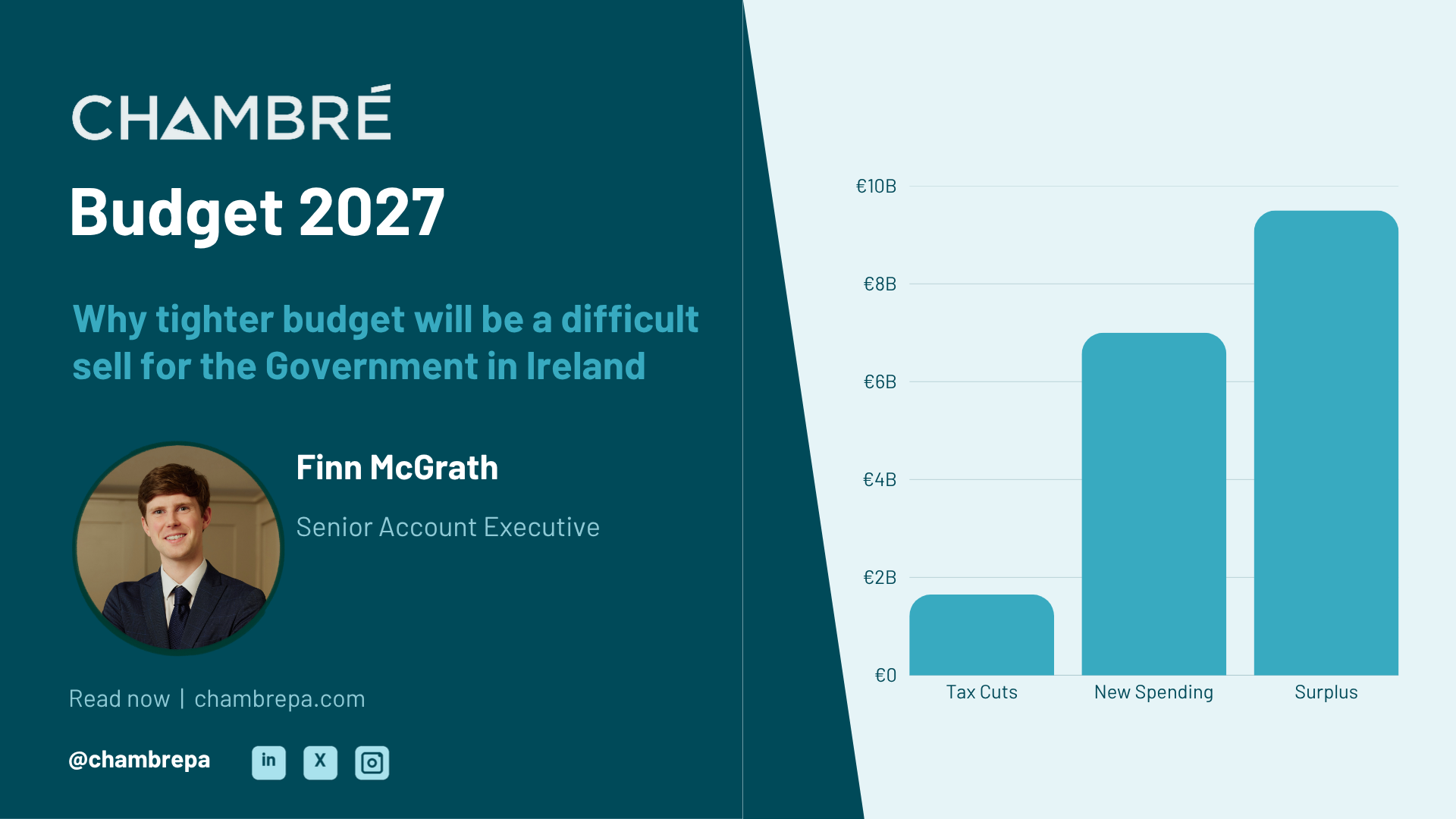
Budget 2027 was paradoxically both a giveaway budget and a tighten your belts budget. The Fianna Fáil-Fine Gael coalition have found themselves in an odd position, where €1.65bn in new tax breaks and €7bn in additional spending seems miserly in the context of a strong fiscal position and a cost of living crisis.
Ireland’s economy is set to grow by 3% next year; indeed, Minister for Finance Simon Harris acknowledged that, “in the context of wars, trade disputes and energy crises, it is quite phenomenal”.
The Government will run a surplus of €6.7bn in 2026 and €9.5bn in 2027. However, Minister for Public Expenditure Jack Chambers fought hard to limit the annual increase in spending by departments to just 6%, when it has crept up to 9% or 10% in recent years.
Why, then, if the economy is in good shape, has the Government put itself on such a strict diet?
The reason is that Ireland’s tax base is astonishingly brittle. About 30% of the country’s total revenue comes from corporation tax, and earlier this year the Irish Fiscal Advisory Council reported that just 3 firms – Apple, Microsoft, and Eli Lilly – paid 46% of all corporation tax collected in 2024. This means that about one in every seven euro the Government has to spend comes from just three companies.
This creates uncertainty, both in the sense that there is risk that revenue could vanish, but also in that the amount of money available is hard to predict. The Parliamentary Budget Office reported earlier this year that the Department of Finance has underestimated how much corporation tax would be paid for 14 years in a row. This makes it difficult to plan ahead and make adjustments that have a lasting impact.
The measures in this budget reflect that reality. The two flagship announcements were a personal income tax package targeting the “squeezed middle”, worth about €700 to someone on €50,000 a year, and a one-off “cost of disability” payment of €500. Though significant, neither of these steps could be considered inflation-proof. Cuts to carbon tax on home heating oil and freezing fuel excise rates will provide some temporary relief to those struggling with energy costs, but if oil prices jump again in the next year those gains will be eroded, if not wiped out entirely. Indeed, Sinn Féin TD Pearse Doherty’s line that this is a “gone before you get it” budget will ring true to many voters.
The coalition will struggle to sell this budget offer to a public who are feeling the pressure of higher prices. According to an Irish Times/Ipsos polling conducted in September, more than half of all voters (51%) said they found it “a lot more difficult” to manage financially.
While there are plenty of small measures designed to give people some breathing room, there is almost nothing in Budget 2027 that actually decreases the sticker price of any essentials. There were exceptions to this trend for young families and university students: childcare fees have been capped at €550 per month, down from €735, and tuition fees have been cut to €2,350, down from €2,500. However, on childcare the coalition is still a long way from achieving the €200 per month target set out in the Programme for Government. And many students will recall paying just €2,000 in fees in 2024, when outgoing Government announced a larger but temporary cut ahead of the last election.
Budget 2027 does not chart a course away from the cycle of giveaway budgets. Social Democrats deputy leader Cian O’Callaghan described it as “devoid of ambition and new ideas”. This is most apparent when it comes to energy, where the decision to slash carbon tax while increasing the retrofit budget by just 2% smacks of short-termism. Indeed, even Fuels for Ireland, a trade body for the oil industry, said the move “postpones the fundamental question of what a coherent, sustainable approach to fuel taxation and affordability should look like”.
This year’s budget exposes some of the fundamental issues with the Irish state’s finances. Successive Fianna Fáil and Fine Gael governments have boxed themselves into a corner, where the runaway success an economic model based on attracting major American companies has created a windfall that the State is not equipped to spend in a sustainable manner. Making Ireland a more affordable place to live in the long-run eludes them. Unless something major changes, we should expect more of the same at Budget 2028.
Finn McGrath is a Senior Account Executive at Chambré
